Laser tattoo removal can make an unwanted design substantially lighter, remove selected sections, or create a cleaner surface for a cover-up. By comparing the likely endpoint, laser wavelength, session schedule, recovery and risks, you can decide whether treatment suits your tattoo and skin rather than expecting a one-visit result.
Key takeaways
- Expect reduced visible ink, not complete removal after one appointment.
- Laser pulses fragment pigment while your body clears it between sessions.
- Sessions are spaced weeks apart to allow treated skin to heal.
- Compare consultation, laser type, session plan, risks, and aftercare before booking.
What benefits can laser tattoo removal provide?
The practical benefit is reduced visible ink, not a tattoo burned away in one appointment. Laser tattoo removal in Punawale uses selective pulses to fragment tattoo pigment, which the body clears between sessions. Results are judged after a course of treatment, not immediately after a visit.
| Option | Practical result | What to expect |
|---|---|---|
| Complete removal | No visible tattoo pigment to the unaided eye | This is an endpoint, not a promise of perfectly normal skin. A faint ghost image, altered colour or texture, or scarring can remain. |
| Substantial fading | The tattoo becomes much lighter and less noticeable | Residual ink can remain, especially in dense professional tattoos, layered designs, cosmetic pigment, or previously treated skin. |
| Cover-up preparation | The old design is lightened enough for a new tattoo | The tattoo artist decides how much fading is needed; complete removal is unnecessary when the new design can conceal the remaining ink. |
Your likely result depends on ink colours, pigment depth and density, tattoo age and location, skin tone, smoking, and your body’s clearance response. A consultation should examine the tattoo rather than rely on a photograph, then discuss the likely session number, cost, risks, and whether a test spot is appropriate.
Temporary lightening or darkening of surrounding skin remains possible.
How the laser targets ink without simply burning off the tattoo
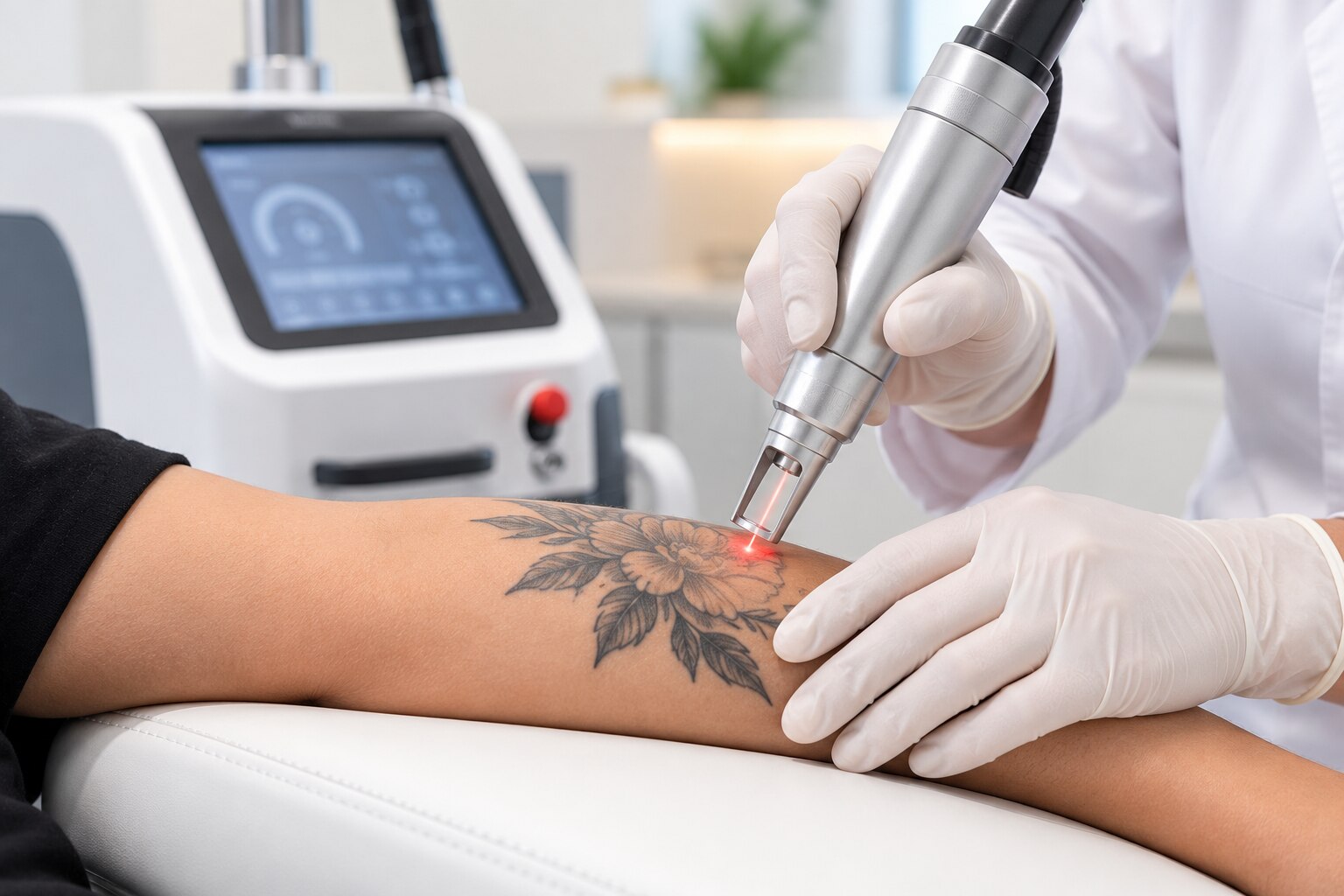
A laser pulse does not scrape or peel the tattoo away. It delivers concentrated energy that the ink absorbs more strongly than the surrounding skin. The pigment heats and fractures into much smaller particles, while the skin is exposed for only an extremely short time.
Your immune system then carries away some of those particles through normal clearance pathways.
The correct wavelength matters because each ink colour absorbs light differently. During tattoo removal treatment in Punawale, the clinician selects a laser wavelength that matches the pigment rather than simply choosing the newest machine.
| Laser option | Common target | Important limitation |
|---|---|---|
| Q-switched or picosecond 1064 nm | Black and dark ink | Dark blue may respond, but depth and density still matter |
| Q-switched or picosecond 532 nm | Many red, orange and some yellow pigments | It interacts more strongly with melanin |
| 755 nm | Selected blue and green pigments | Results depend on the exact ink formulation |
| 694 nm | Selected blue and green pigments | Requires careful selection for your skin type |
Skin tone also affects settings. Melanin absorbs some laser energy, so darker skin has a higher risk of temporary lightening, darkening or burns if treatment is too aggressive. Conservative energy levels, appropriate wavelength selection and a test spot can reduce that risk.
Ink placed deeply, densely or in several layers takes longer to fragment. Professional tattoos often contain more pigment than amateur tattoos, so fading is not determined by colour alone.
Why removal takes several sessions spread weeks apart
A tattoo needs several sessions because each laser treatment breaks only part of the ink into particles that your body can remove. The usual interval is 6–8 weeks, giving inflammation time to settle and immune cells time to clear the fragmented pigment.
The number of sessions for laser tattoo removal in Punawale depends on:
- Ink colour, because some pigments respond better to particular wavelengths
- Pigment depth and density, since dense or deeply placed ink takes longer to fragment
- Tattoo age and size
- Professional application, layering, or previous treatment
- Tattoo location and local blood circulation
- Your skin tone, smoking status, and immune response
Many professional tattoos need about 6–10 sessions, and some require more. At 6–8-week intervals, six sessions take roughly five to eight months, while ten sessions can extend the course to about nine to seventeen months. Your endpoint also matters: preparing the area for a cover-up may need fewer sessions than pursuing near-complete removal.
Treating the tattoo again after only a short gap does not make pigment disappear faster. The laser has already delivered its energy; your body still needs time to transport and clear the particles. Retreatment before the skin recovers can increase redness, irritation, blistering, and pigment changes without improving clearance.
A photograph alone cannot reliably predict the final session count, so an in-person assessment is important.
What happens during treatment and while the skin heals
At the appointment, the clinician examines the tattoo, cleans the skin, provides protective eyewear, and selects laser settings for your ink and skin tone. During tattoo removal treatment in Punawale, each pulse can feel like quick elastic-band snaps with heat. Treatment ends with cooling and dressing or ointment instructions.
Redness, swelling, warmth and a temporary white “frosted” appearance are common immediately afterward. Pinpoint bleeding, blisters or crusts can develop over the next day; do not pop, scratch or peel them. Darkening or lightening of the surrounding skin can occur, especially after tanning or with darker skin tones.
- Keep the area clean and dry according to the clinician’s instructions.
- Apply only the recommended ointment and change any dressing as directed.
- Protect the treated skin from direct sun; once healed, use broad-spectrum SPF 30 or higher and cover the area.
- Avoid picking, tight clothing, vigorous rubbing, swimming and activities that dirty the wound until the surface has healed.
- Contact the clinic for spreading redness, worsening pain, pus, fever or bleeding that does not stop.
| Reaction | Usually expected | Seek advice |
|---|---|---|
| Redness or swelling | Mild and temporary | Worsens or spreads |
| Blister or crust | Heals without picking | Pus, severe pain or fever |
| Colour change | Fades gradually | Persists or becomes prominent |
How to compare a clinic’s plan before you commit
A good consultation for laser tattoo removal in Punawale examines the tattoo, not just a photograph. Ask the clinician to assess its colours, age, location, density, depth, previous treatment, and your skin type before estimating sessions or cost. A photo alone cannot predict the final result.
Ask these questions during the appointment:
- Which laser and wavelength will you use for each ink colour—Q-switched or picosecond—and why is it suitable for my skin tone?
- Will you perform a test spot? This matters for white, pastel, flesh-coloured, or cosmetic inks that can darken after laser exposure.
- What medical history changes the plan? Mention keloids, abnormal scarring, active infection, recent tanning, and photosensitising medicines.
- What endpoint is realistic: complete removal, substantial fading, or preparation for a cover-up?
- What risks apply to me, including pigment changes, scarring, texture change, incomplete removal, and infection?
- Is the quote per session or for a package, and what happens if I need more sessions?
Compare cost estimates in this format:
| Quote detail | More useful | Less useful |
|---|---|---|
| Per-session price | States laser, area, taxes, and aftercare | Gives one unexplained figure |
| Course estimate | Shows likely range and spacing | Promises a fixed number |
| Package price | Explains refunds and unused sessions | Requires payment before assessment |
Take the same checklist to Aesthetic Plus Clinic -Skin Specialist 08048033198 when comparing tattoo removal treatment in Punawale. Insist on written aftercare and a review plan.
Related service
Skin Treatments Laser Tattoo Removal in Punawale, Pune Laser Tattoo Removal Treatment in Punawale, Pune Dr Nisha’s Aesthetic Plus Clinic – Personalised Care for Unwanted Tattoo Removal Have an unwanted... View service → |
Frequently asked questions
What benefits can laser tattoo removal provide?
Laser tattoo removal can reduce the visible intensity of tattoo ink without cutting or scraping the skin. The outcome depends on factors such as ink colour, tattoo age, depth, size, and your skin’s response.
How does the laser target ink without simply burning off the tattoo?
The laser delivers short, selective pulses that fragment pigment particles. The body then clears the smaller particles over time; the laser does not peel the tattoo off in one treatment.
Why does tattoo removal take several sessions spread weeks apart?
Each session reaches only part of the pigment, and the skin needs time to recover while the body clears fragmented ink. Your clinician sets the interval based on healing and treatment response.
What happens during treatment and while the skin heals?
During treatment, you may feel snapping or heat as the laser passes over the tattoo. Redness, swelling, tenderness, or blistering can occur afterward, so follow the clinic’s wound-care instructions and protect the area from sun exposure.
How should you compare a clinic’s tattoo-removal plan?
Ask which laser technology suits your ink, who will perform the treatment, how many sessions are estimated, what interval is planned, what side effects are possible, and what aftercare is included.
Keywords